

MSU SRC Hosts Computational Systems Toxicology: Modeling and Informatics Workshop
May 12, 2026
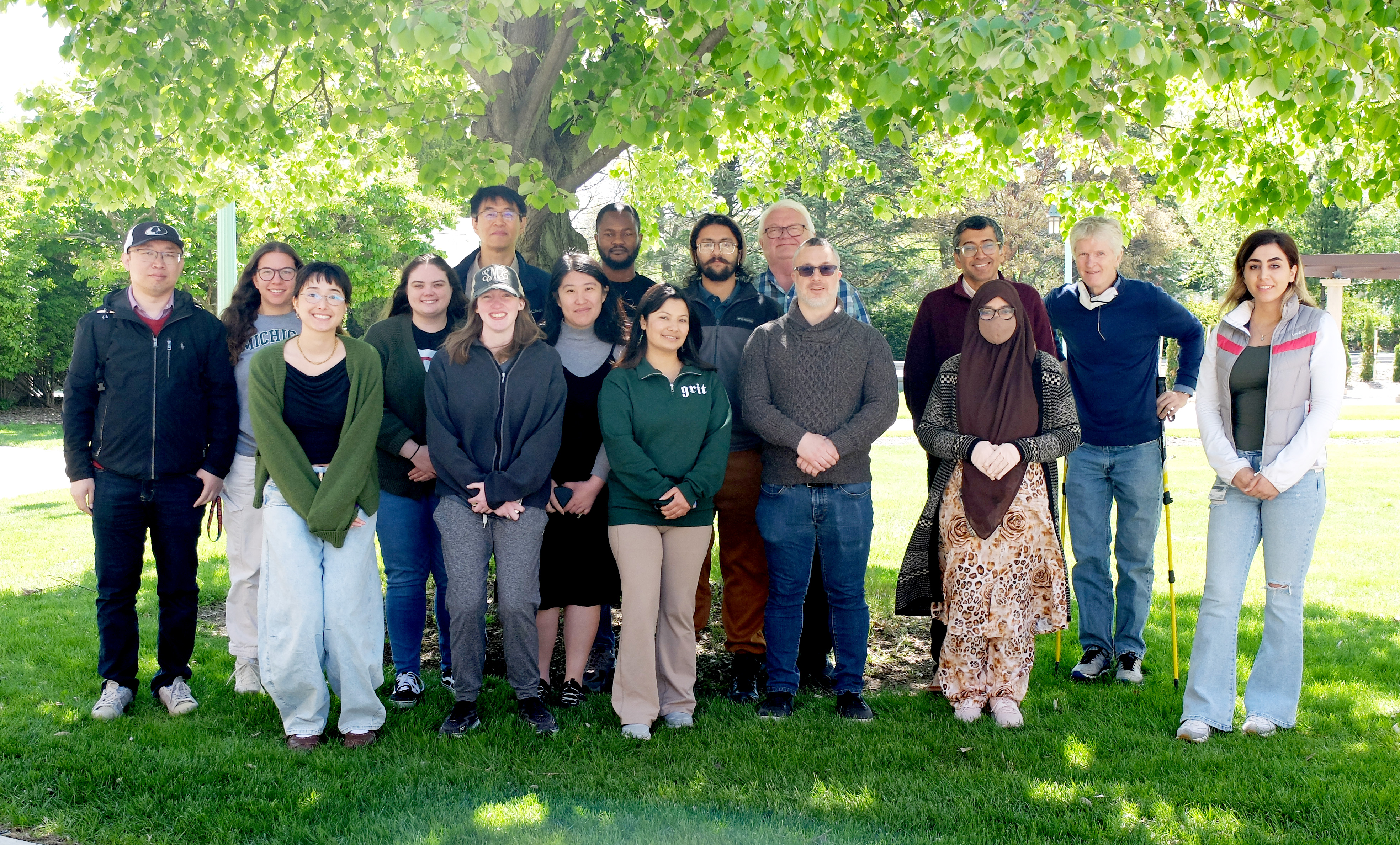 The MSU SRC recently hosted the Computational Systems Toxicology: Modeling and Informatics (CSTMI) Workshop on May 7 - 10, 2026 at the Food Safety and Toxicology Building on Michigan State’s campus. Course instructors were Sudin Bhattacharya and Rance Nault from Michigan State University, Qiang Zhang from Emory University, and Eberhard Voit from the University of Texas at Dallas.
The CSTMI workshop was attended by 24 students and covered dynamical systems modeling technique for quantitative simulation of biological responses to perturbations at the molecular, cellular, tissue, and body levels, and how to build quantitative adverse outcome pathway (qAOP) models. As well as analysis single-cell and spatial -omics data toward classification of cell types, inference of biological pathways, and prediction of cellular outcome trajectories. Upon completion of the workshop, students gained knowledge in:
- Common network motifs in signal transduction and gene regulatory networks that underlie cellular and physiological systems-level behaviors, including signal amplification, homeostasis, adaptation, threshold responses, binary fate decision-making, and biological rhythms.
- Molecular feedback and feedforward circuits comprising genes and proteins that give rise to various dynamic and nonlinear dose-response behaviors. Examples include cellular stress responses, differentiation, cell cycle dynamics, and endocrine regulation.
- Use of these simulation techniques to develop qAOP models as in silico New Approach Methodologies (NAM) tools to bridge the data gap in in vitro to in vivo extrapolation (IVIVE) for next-generation risk assessment (NGRA).
- Commonly used dimension reduction, visualization, clustering, and pseudo-time trajectory algorithms for -omics data. Examples include t-SNE, UMAP, Monocle, RNA velocity, cell-cell communication analysis for single-cell and spatial transcriptomics data.
- Basic programming skills in Python.
- Biological data storage, sharing and management.
The workshop comprised lectures and hands-on computer exercises and was a collaborative effort between the Computational Modeling Core, the Research Experience and Training Coordination Core, and the Data Management and Analysis Core of the MSU Superfund Research Center.